

Introduction
Your chart can seem confusing at first — strange symbols, numbers, houses, and signs everywhere; this guide will help you begin to make sense of it so you can begin to read your Vedic chart.
The chart is simply a map of the sky at the moment you were born.
In Vedic astrology, it is used to understand the patterns of your life: your nature, your emotions, your relationships, your work, your challenges, and the timing of the different phases you move through.
A birth chart is deep, layered, and symbolic. Even experienced astrologers return to the same chart again and again and continue to see new things.
This guide is designed to help you simply begin — to give you a clear starting point.
By the end, you should be able to look at your chart and notice a few important things: your rising sign, your moon sign, your sun sign, the areas of life that are most active, and some of the main themes your chart may be pointing toward.
An important note: while you can find out about your chart here and find interpretations, it is really important to understand that it will mostly be a “cookie-cutter” approach, meaning the information will be a little disconnected. It requires the knowledge of a skilled astrologer to synthesise the chart, and to really understand what is going on. You can get some good glimpses, but there are limitations to reading as a beginner.
It takes years of study to really understand Jyotish (Vedic astrology). So remember that this is just a simple introduction.
How to Read your Vedic Chart – Step 1: Find your Birth Chart
To read your Vedic chart, first we need to to generate it using an online calculator. Use the chart calculator below and enter your birth date, birth time, and birth place. Select the diamond shape at the bottom (North Indian chart) as we will be using North Indian in this guide.
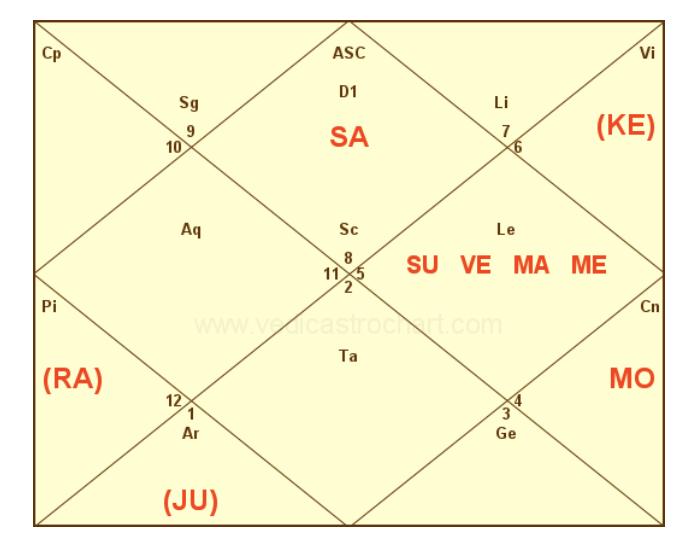
It should look something like this. Don’t worry if it looks confusing. We’ll walk through it step by step. You’ll also see a table beneath the chart that looks like this:

For now, you are only looking for a few key things: Your rising sign, your moon sign, your sun sign, where the planets are placed, and which houses they occupy.
Action: Find your birth chart and table of information.
Step 2 — Understand the Basic Structure
Your birth chart is divided into 12 houses.
Each house represents a different area of your life. The houses are not “good” or “bad” by themselves. They simply show where different kinds of life experience take place.
Important note: The houses are the fixed diamond shaped boxes. The numbers in the chart represent the signs E.g. 1 = Aries, 2 = Taurus. People sometimes get confused because they see the numbers and assume they are the houses.
The first house is the big diamond at the top, then we count the houses from there anti-clockwise. Here is an image of the houses along with what they represent.

You do not need to memorise all of these significations. Just begin to see the chart as a map of life areas.
The planets show what kind of energy is active. The signs show the style or quality of that energy. The houses show where in life that energy plays out.
Action: Understand the houses are the fixed boxes, the signs are represented by the numbers. Planets are shown by abbreviations: Su=Sun Ma=Mars etc.
Step 3 — Find Your Rising Sign

In the table, look at the first row, where it says Ascendant.
This is your rising sign, the sign that was rising over the Eastern horizon when you were born.
The rising sign (lagna) is one of the most important points in the chart. It is the 1st house of your chart, and all the other houses are counted from there.
So your rising sign shapes the basic framework of your life.
It shows your temperament, your physical nature, your general life path, and the lens through which you meet the world.
For example, someone with Aries rising may experience life through action, courage, and initiative. Someone with Cancer rising may be more shaped by sensitivity, family, care, and emotional security. Someone with Capricorn rising may experience life through responsibility, effort, and long-term building.
This gives the foundation, the lens through which we experience and act in the world.
Action: Find your rising sign and search the meaning of that sign; reflect on how that applies to your life. (This guide is not long enough to cover every possibility)
Step 4 – Find your Moon Sign
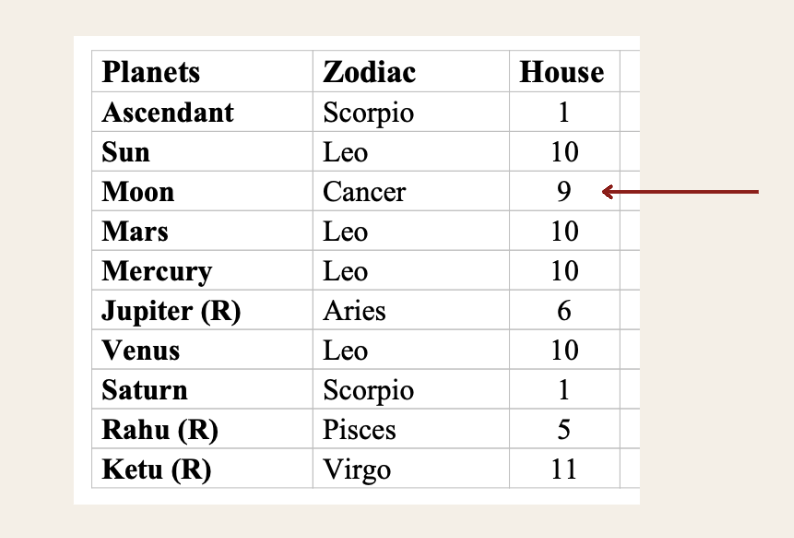
In Vedic astrology, the moon is extremely important. It shows your emotional nature, your mind, your inner world, and how you respond to life.
It often describes what you need to feel safe, steady, and nourished. They say that wherever the moon is, that’s where the mind goes.
The moon sign can describe patterns that feel familiar: how you react under stress, what soothes you, what unsettles you, and how you process experience inwardly.
For example, Moon in Taurus may seek steadiness, comfort, and emotional security. Moon in Gemini may need communication, variety, and mental stimulation. Moon in Scorpio may feel things intensely and may need depth, privacy, and emotional honesty.
It also tells you the house number in the table. If your moon is in the 9th house, you may strongly connect with and understand the world through knowledge, learning, and spirituality. The house placement, in many ways is more important than the sign, as it shows how the energy plays out in our lives.
Action: Find your moon sign/house in the table and search for interpretations, reflecting on how you respond to life, and what nourishes you.
Step 5 — Find Your Sun Sign

Your sun sign shows your sense of identity, vitality, confidence, and direction.
In Western astrology, the sun sign is often treated as the main sign. In Vedic astrology, it is still important, but it is usually less significant than the rising sign and moon sign.
The sun shows something about your inner authority: where you are learning to stand in yourself, express your light, and act with clarity.
It may also show themes connected to father, leadership, purpose, visibility, and confidence.
For example, Sun in Leo may bring themes of leadership, expression, and visibility. Sun in Virgo may bring themes of service, refinement, skill, and improvement. Sun in Pisces may bring themes of compassion, imagination, devotion, and surrender.
If you want to go deeper you can also search for the house meaning.
Action: Find your sun sign (and house) to reflect on your inner authority and how you shine your light.
Step 6 — Understand Lordship
Lordship is one of the most important concepts in order to read your Vedic chart.
Each sign is ruled by a planet. That planet is called the lord or ruler of the sign.
1. Aries is ruled by Mars
2. Taurus is ruled by Venus
3. Gemini is ruled by Mercury
4. Cancer is ruled by the Moon
5. Leo is ruled by the Sun
6. Virgo is ruled by Mercury
7. Libra is ruled by Venus
8. Scorpio is ruled by Mars
9. Sagittarius is ruled by Jupiter
10. Capricorn is ruled by Saturn
11. Aquarius is ruled by Saturn
12. Pisces is ruled by Jupiter
In Vedic astrology, we often look at the lord of a house to understand how that area of life functions.
For example, 10th house represents career, so we look not only at the 10th house itself, but also at the planet that rules the sign in the 10th house. Where that planet is placed gives more information about your career path.
This can sound technical, but the idea is simple:
The house shows the area of life. The lord shows where that area of life is being directed.
For example, if the 10th lord is in the 9th house, career may connect with teaching, travel, wisdom, spirituality, or higher education. If the 7th lord is in the 12th house, relationships may connect with foreign places, sacrifice, spirituality, or endings and letting go.
Action: Read the list above to know which planet rules which sign. No need to memorise for now.
Step 7 — Explore Career: The 10th House/Lord

Start by looking at the sign in your 10th house. Remember: the little numbers in the chart represent signs, not houses (5=Leo, 6=Virgo etc)
The sign gives some indication of the style of your work and public expression.
Next, find the planet that rules that sign. This is called your 10th lord. (Refer to the list from Step 6.)
Then find where that planet is placed in your chart.
E.g. If Leo is in the 10th house (as in the chart above), then Sun becomes the 10th lord, and therefore a strong indicator of career.
If the 10th lord is in the 2nd house, career may connect with speech, teaching, money, food, or using the voice. If the 10th lord is in the 9th house, career may connect with teaching, spirituality, travel, publishing, or higher learning.
Action: Find your 10th lord and notice which house it sits in. Reflect on how those themes may connect with your work or contribution in life.
Step 8 — Explore Relationships: The 7th House/Lord
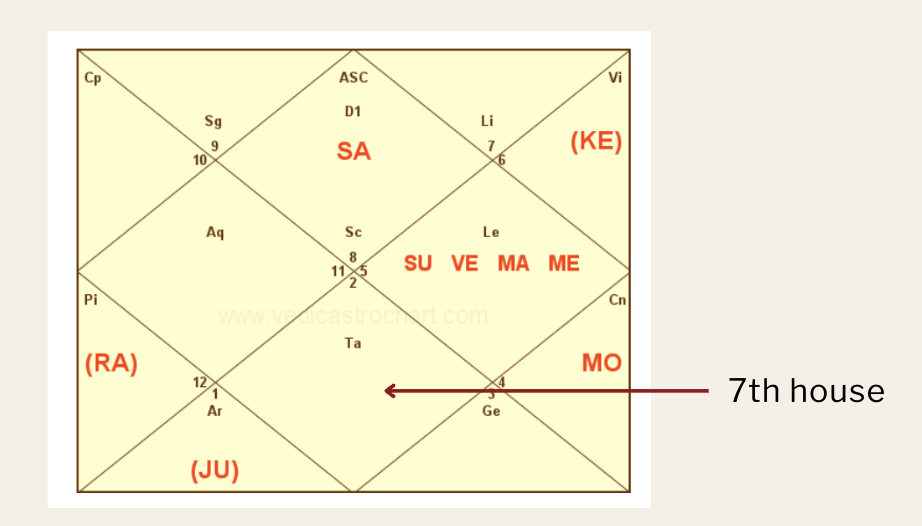
The 7th house represents relationships, partnership, marriage, and how you connect with other people.
Start by looking at the sign in your 7th house. This can give some indication of the qualities you may seek or experience in relationships.
Then find the planet that rules that sign. This is called your 7th lord. (Use the list from Step 6.) Now find where that planet is placed in your chart.
This gives more information about how relationship themes may unfold in your life.
For example if the 7th lord is in the 4th house, relationships may connect strongly with home, family, emotional security, or building a stable inner life.
If the 7th lord is in the 8th house, relationships may bring deep transformation, intensity, vulnerability, or psychological growth.
You can also notice whether any planets sit directly in the 7th house itself. These planets often strongly influence relationship experience.
Action: Find your 7th lord and notice which house it sits in. Reflect on how those themes may connect with your relationships.
Step 9 — Notice Houses with Multiple Planets
When several planets gather together in one house, that area of life becomes emphasised. It does not mean the area will be easy or difficult by default. It means it is important.
A house with multiple planets often becomes a major life focus. There may be more activity, more lessons, more complexity, and more growth connected with that house.
For example, several planets in the 4th house may show a strong focus on home, family, emotional foundations, property, or inner life.
Several planets in the 9th house may show a strong focus on spirituality, teachers, study, travel, dharma, or higher wisdom.
Several planets in the 10th house may show strong career focus, visibility, ambition, work, or public responsibility.
When looking at a cluster of planets, ask:
- Which house are they in?
- What area of life does that house represent?
- Is this an important theme in my life?
This is often one of the easiest ways to begin reading a chart.
Action: Notice if two or more planets are together in any one house and find the themes of that house.
Step 10 — Look at Rahu and Ketu’s House Position
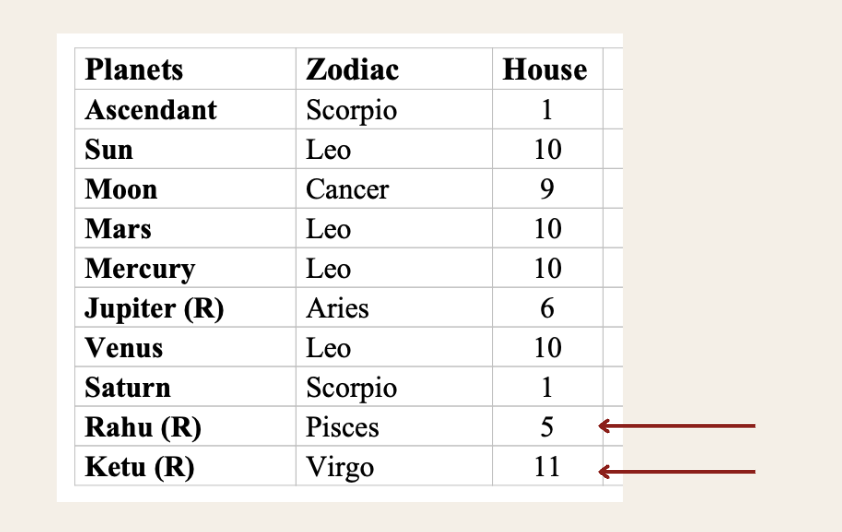
Rahu and Ketu are the lunar nodes. They are not physical planets, but they are extremely important in Vedic astrology. They show karmic themes, growth points, attachments, fears, and areas of life that feel intense or unusual.
Rahu shows where life may pull you forward. It can show desire, ambition, fascination, hunger, and areas where you are learning through experience.
Ketu shows where there may be detachment, past-life familiarity, dissatisfaction, spirituality, or letting go.
Together, Rahu and Ketu form an axis. This means they always sit opposite each other in the chart. They show a major life lesson.
For example, Rahu in the 10th and Ketu in the 4th may point toward learning to move into public life, career, or visibility, while also working through attachments or complexities around home and emotional security.
Rahu and Ketu can feel intense, but they show important areas of growth.
Action: Find the houses Rahu and Ketu are placed in and search for what life lessons are associated with the axis.
Read your Vedic Chart – Final Step: Don’t Try to Understand Everything
A birth chart is not meant to be understood all at once. If you try to interpret every planet, house, and sign immediately, you will feel overwhelmed.
Start simple. Just try and get a few insights at a time.
Notice:
- Your rising sign
- Your moon sign
- Your sun sign
- Your 10th house
- Your 7th house
- Any house with several planets
- Rahu and Ketu
That’s already a lot.
Remember that you have free will, and that you are greater than your chart. Your chart is a static portrait, fixed in time. You are a moving, living entity, walking through God’s time with a combination of karma and free will.
Use your chart to gain helpful insights, but do not over-identify with it or put yourself in a box (E.g. “I am just like that because my chart says so.”)
You can always overcome your patterns and tendencies.
A good reading should help you understand yourself with more compassion, and not limit you to any one fixed version of reality.
If you ever feel yourself over-identifying or limiting yourself, chant to Lord Ganesha: Om Gam Ganapataye Namaha. He removes obstacles of this nature.
If You’d Like to Go Deeper…
This guide is a starting point. I hope it’s helped you begin to read your Vedic chart.
A birth chart is rich and layered, and it can be difficult to know what matters most without guidance.
In a one-to-one Vedic astrology reading, we look at your chart together and focus on what is most relevant for your life right now: your current phase, your patterns, your relationships, your work, your timing, and what may be unfolding next.
An astrology reading helps to integrate and synthesise the information you find in your birth chart.
If you’d like support understanding your chart more deeply, you’re welcome to book a one-to-one Vedic astrology reading.
Just click the button below or visit the Readings page
